100,000 letters to the North Pole.

Somewhere in Wollongong on a Tuesday night in December 2024, a seven-year-old watched a video of an old man at a desk in the North Pole pick up a letter, adjust his glasses, and read her name out loud. She screamed. Her mum cried a bit. Then she sent it to eleven people, because that is what you do.
We made a hundred thousand of those. This is the story of how, and — more usefully — what two Christmases of it taught me about the parts of the job you actually control.
What Santa AI actually was
Christmas 2024. A creative partner walked in with an idea — the kind that sounds obvious the second you hear it and was not obvious a minute before: let people nominate a child for Santa’s Nice List. Name, age, town, and one line about why they deserve it. That was the spark, and it arrived from outside, the way the best sparks usually do.
What happened next is the part case studies flatten. An idea is not a product — between the two sits everything: the customer journey, the pipeline that has to survive holiday volume, the promotion that gets it in front of people, and the thousand small decisions that keep the magic intact from nomination to delivered video. That distance was closed by a room — strategists, writers, designers, engineers, martech people — arguing well, each owning a piece nobody else could build. Nobody in that room could have shipped it alone, including us. The AI was the delivery mechanism. The collaboration was what made it magical.
That is the whole ask. No account. No purchase. No twelve-field form designed by a committee that has never met a parent in December.
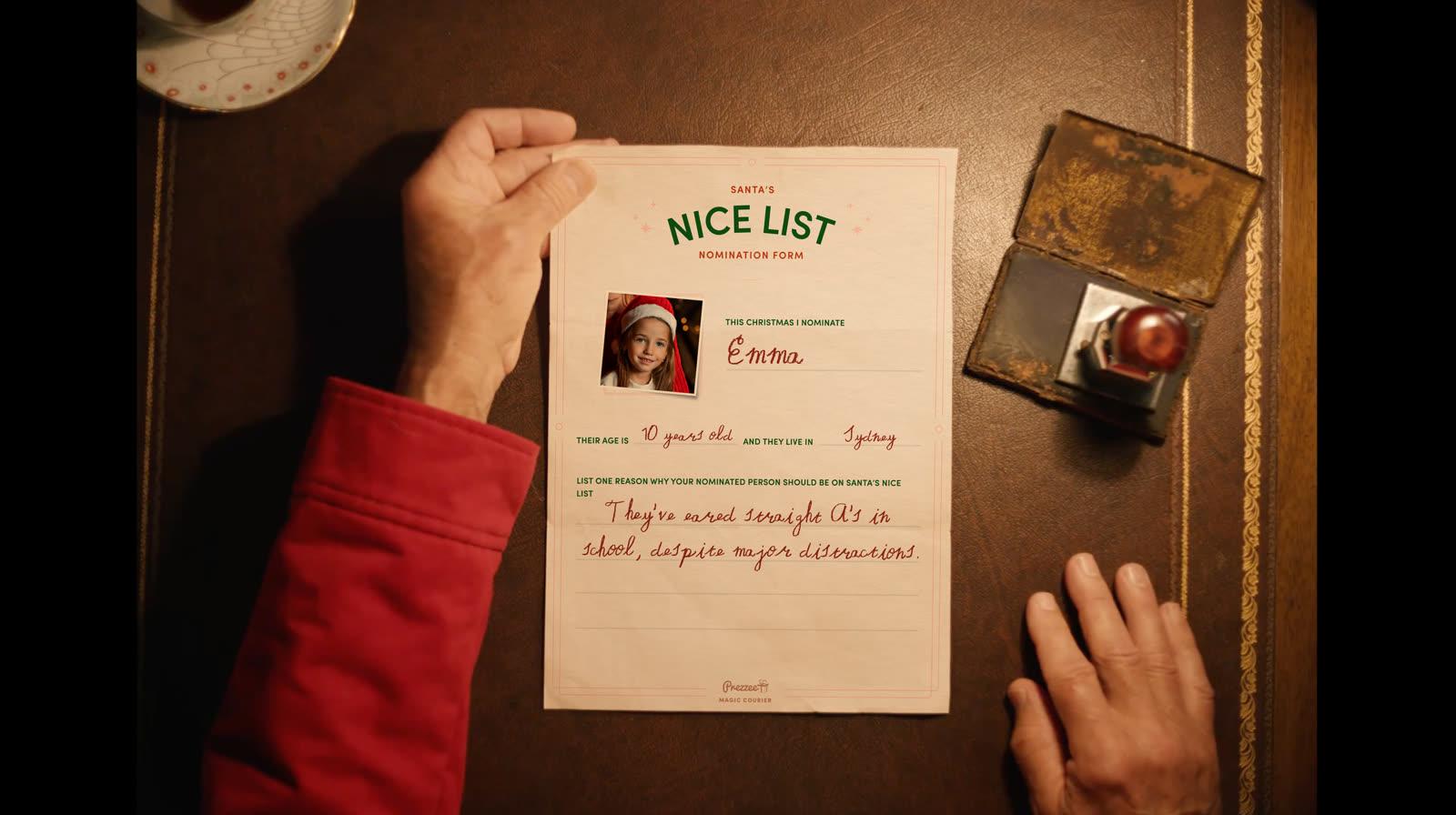
What happened next is the part people remember. Our martech stack and AI engine took that nomination and produced a personalised film of the letter’s journey: posted, carried, flown north, landing on the desk at the North Pole, reviewed, and approved by Santa himself. Your kid’s name, in Santa’s hands, in his study, with the fire going.
Technically it is a pipeline — identity, personalisation logic, video generation, delivery, all wired to run at holiday-season volume without a human touching each one. Emotionally it is a seven-year-old finding out she made the list. Only one of those descriptions matters to the person watching, and it is worth remembering which.
The numbers, before the philosophy
Because I promised receipts, and because a story about magic with no measurement is just vibes with a budget.
Personalised videos produced
People reached
Expected site traffic
Markets: AU, NZ, UK, US
The traffic figure is the one that gave our infrastructure team a memorable fortnight. Six times what we forecast. Word of mouth did that, not media spend — parents sending it to other parents, group chats doing what group chats do. Then the awards followed: recognition at The Drum Marketing Awards, an AMI Excellence Award, Best Use of Marketing AI at Martech APAC. Lovely. Genuinely. Also the least interesting thing on this page.
Nobody has ever shared a funnel
Here is the uncomfortable truth at the centre of this: we did not go viral because we were clever about distribution. We went viral because the thing was worth sending to your sister.
That sounds like a greeting card, so let me put it in operational terms. Every growth lever a marketing team pulls — spend, targeting, cadence, subject lines, incentives — is an attempt to manufacture a decision that happens in somebody else’s nervous system. You can improve the odds. You cannot make the call. The only real leverage you have is whether the thing on the other end of the click deserves the seven seconds it takes to forward it.
You control the offering. You do not control the outcome. Most marketing teams have this exactly backwards, and it is why they are exhausted.
The Stoics had a name for this and they were not being poetic about it. Epictetus opens the Enchiridion by dividing the world in two: what is up to us, and what is not. Our judgements, our efforts, our choices — ours. Reputation, results, other people’s reactions — not ours. He was not telling you to stop caring. He was telling you to stop spending your finite attention on the half you cannot move.
Some things are within our power, while others are not. Within our power are opinion, motivation, desire, aversion — in short, whatever is of our own doing.— Epictetus, Enchiridion
Stoic analytics: work the inputs, read the outputs
This is where the philosophy stops being decorative and starts being a dashboard.
Split the board in two. Column one is what your decisions produce directly: time from nomination to delivered video, render failure rate, cost per asset, the share of experiences that complete without a human touching them. Column two is what the world decides: reach, shares, sentiment, awards, whether a morning show picks you up.
Column one is your job. Column two is your scoreboard. The mistake is not watching column two — you would be negligent not to. The mistake is trying to operate it directly, because there is no lever in the building marked “reach”.
What there is, if you go looking, is a short list of column-one numbers that actually drag column two along behind them. Finding that list is the entire job.
Instrument backwards from the thing you want
We stopped asking “how many shares did we get” and started asking “what is true of the experiences that got shared?” Same data, completely different question. The first is a report. The second is a hypothesis you can test on Monday.
Three things came out of it, and they were not the three we would have guessed.
Delivery latency was the strongest lever we had. The gap between hitting submit and the video landing predicted completion better than any creative variable we tested. Magic has a shelf life measured in minutes — a parent who has to come back later is a parent who mostly does not. Every minute we cut moved the number that we were not allowed to touch.
Render failure was not a neutral event. We had been treating failures as a cost problem — wasted compute, retries, a support ticket. In the data they behaved like negative shares: a broken experience does not just fail to spread, it actively costs you the person who would have spread it. That reframing moved failure rate from an engineering hygiene metric to the top of the board.
And the reveal beat mattered more than the production value around it. Where the child’s name landed in the video timeline — how early, how clearly — separated the experiences people forwarded from the ones they merely watched. Not the lighting. Not the score. The moment of recognition, and how fast you get to it.
The tax on being early
Here is the part the case studies leave out: those failures existed because we were pushing technology that was not ready to be pushed. Personalised generative video at holiday volume, in 2024, was the frontier — and the frontier charges rent. Some renders break in ways nobody has seen before. Some costs only reveal themselves at six times forecast. That is not bad engineering. That is the tuition of being first, and it is only a problem if you pretended the course was free.
So budget the innovation tax like a line item, because that is what it is. A team that expects a clean launch from frontier tech will read every failure as a crisis and retreat. A team that priced the failures in reads them as the syllabus — each broken render at 2am was the system teaching us what version two needed to be. You do not get the hundred thousand magical experiences without paying for the ones that broke. The only real choice is whether you pay it knowingly, or resentfully.
Strategy for lightning
Nobody can predict an explosive success. Fourteen million people was not the plan — there was no slide with that number on it. If your strategy requires the explosion, you have a wish with a budget attached.
What you can do is raise the odds, and that job has three parts you fully control: a strategy you believe, an experience worth someone’s evening, and an audience you know cold. Ours was a parent, in December, who wants their kid to feel chosen. Aim everything at that one person and you still get no guarantee — you are just the thing standing where the wind tends to blow.
You cannot predict lightning. You can build the tallest rod in the neighbourhood.
And aim is learnable. Year one told us where we were off — too slow to deliver, too casual about failures, too late to the reveal — so year two aimed better. Roger Enrico called his cola-wars memoir The Other Guy Blinked, and the title is the whole lesson: campaigns are won by the team still aiming calmly while everyone else flinches. That is what the automation buys. Not savings — reps. Keep firing, keep learning, keep standing there. Eventually the other guy blinks.
Close the loop, or none of it counts
A finding you cannot act on before the next run is trivia. The year-two rebuild aimed at the three that mattered: latency at the ninety-fifth percentile, failures counted as lost customers, the name into frame sooner.
That is the whole discipline: control what you control, learn what the last run taught, aim again. The scoreboard takes care of itself — or it does not, and either way you know what to do on Monday.
What an award actually buys you
Not the trophy. The permission.
Before Santa AI, every AI proposal in the building had to argue for its own existence from first principles, like a philosophy undergrad at Christmas dinner. Afterwards, the conversation flipped from “will this work” to “what do you need”. An award is organisational trust, laminated. And trust, like fitness, decays if you sit on it.
So we spent it immediately. The agentic campaign automation that now runs large parts of our lifecycle programme got approved in a fraction of the time Santa AI did — not because the business case was stronger, but because we had receipts. Ship one visible, slightly unreasonable thing and you change the physics of every proposal that follows it.

Which brings me to the AI Carolers, who sang their way into a lot of living rooms and deserve their own thousand words rather than a footnote here. Next post.
The part I would tattoo on a briefing document
Do not build the AI experience your steering committee imagines. A steering committee has never once been visited by a moment of genuine customer need.
Build for one specific, describable human moment — a parent at 9pm in December wanting their kid to feel chosen — and be fast enough to matter inside it. Then let go of the rest, because the rest was never yours.
Awards are a lagging indicator of that choice. So is revenue, come to think of it. The leading indicator is whether one real person, in one real moment, felt something true. Everything else is column two.
No comments yet — the floor is yours. Tap tap… is this thing on?