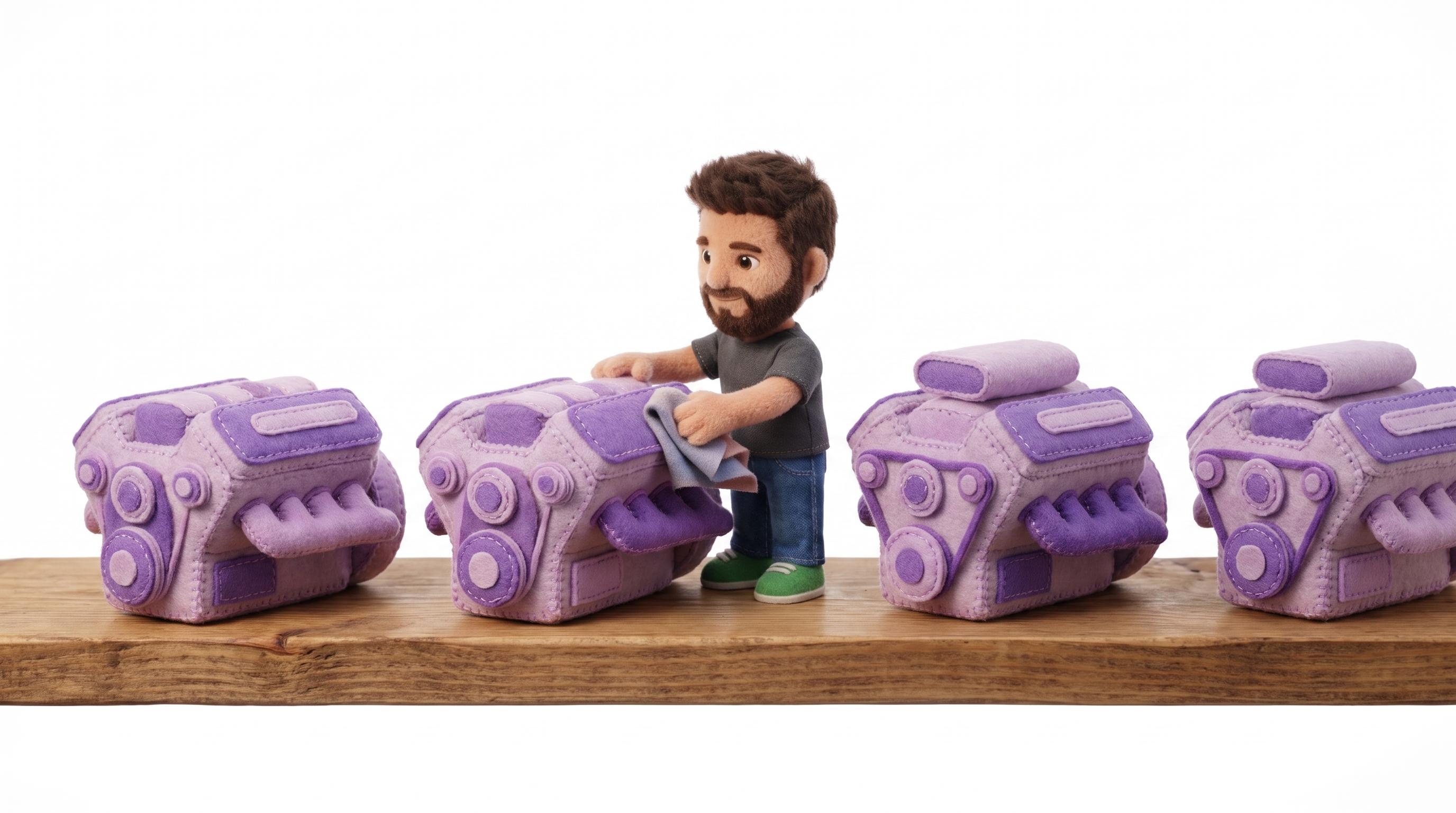
The Parts Department.
Ten systems. Every part on the wall.
The tour out front is seven bays and one argument. This is the other room — the one nobody photographs, where the stock lives and the labels are honest.
A car has systems, not categories.
Ask a mechanic what they work on and they will not say “tools”. They will say fuel, wiring, ignition, exhaust, brakes. The systems are how the car actually fails, so they are how the workshop is actually organised. Martech maps onto them almost exactly — and once you file it that way, a stack stops being a logo grid and starts being a machine with parts that can each be wrong on their own.
Which leaves the question every tool wall dodges. Not what have you heard of — everyone has heard of everything. The question is which of these you have actually had in your hands, at what depth, and what you learned that cost you something. So every part here hangs in one of four places, and one of those places is a bin.
On the bench
Out every day. Worn handles.
In the toolbox
Shipped in anger. Would again.
On the high shelf
Know it, watched it, haven’t lived in it.
In the parts bin
Retired, or wouldn’t reach for it now.
The bin is the one that matters. A wall where everything is a strength is a CV. A wall that admits what it stopped reaching for is a workshop — and every workshop on earth has a drawer of things it does not use anymore.
10 systems · 69 parts · one opinion per shelf, minimum
The counter — tell me the noise
0/10 drawers pulled
Nobody walks into a parts department asking for the exhaust shelf. They walk in with a sentence. Pick the one that sounds like your week and the right drawer comes out.
The cabinet — ten drawers, one car
Your parts list
0 of 69 parts
Empty, for now. Pull a drawer, open a part, and add the ones worth arguing for. Whatever you put on this list, you take with you.
And the wall is being rebuilt while we stand in front of it…
The sockets moved. The work did not.
For twenty years the shape of this trade was fixed: every tool owned its data, and integration meant paying somebody to build a pipe between two things that did not want to talk. The wall above is organised the way it is because that was true.
It stopped being true remarkably fast. MCP turned the integration question into a socket standard, and the CDPs followed — a customer data platform that an agent can query and act through is a different product from one that exports a nightly file, even when the logo has not changed. The tools on these shelves are quietly becoming servers.
The CDP became a server
Identity resolution used to end at an export. Now the same profile is reachable live by something that can act on it — which promotes every unresolved identity from a reporting nuisance to an operational risk.
The moat moved to meaning
Every vendor’s demo chatbot works. Against your actual warehouse, the line between impressive and trustworthy turns out to be whether anyone ever wrote down what the metrics mean. Model choice is a footnote next to that.
The veto became the design
An agent does not make worse calls than a human — it makes them faster, and without embarrassment. “Who can stop this before it sends” used to be a line in a policy doc. It is now a box on the architecture diagram.
Here is the part nobody selling you an agent will say out loud: none of this replaced the homework. The plan, the arbiter, the consent record — the agents did not automate any of it away. They turned it into the difference between an assistant and a liability. The shelves changed. The homework is the same homework, and it just stopped being optional.
So — six systems, one brief. Build the car.
The parts are easy. The car is the hard part.
Anyone can name a good tool. The job is making six of them agree under a real constraint — which is why this grades your build by its worst part, and then grades the joins between them. Six defensible choices can still produce a car that will not start.
The build bay — pick the car you are building
Three briefs. Each one wants six systems specced, and the same part is the right answer in one of them and negligence in another. There is no score — there is a road test, and it grades the build the way a peak weekend does.
Take the list. It was never the tools.
Every part on this wall is available to anyone with a purchase order. What is not on the wall — the order you walk the bays, the question you ask before you reach — is the part nobody sells.
The Parts Department — Martech Garage · Sydney, AU